


























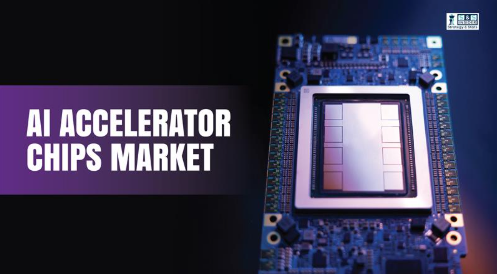
The global semiconductor industry is undergoing a transformative phase as artificial intelligence becomes deeply embedded across industries. One of the most critical enablers of this transformation is specialized computing hardware designed to process AI workloads efficiently. As data volumes surge and models grow increasingly complex, demand for purpose-built processors is accelerating rapidly. This momentum is reshaping investments, innovation strategies, and competitive dynamics across the technology ecosystem.
The AI Accelerator Chips Market has emerged as a cornerstone of next-generation computing infrastructure. The market size was valued at USD 28.51 billion in 2024 and is projected to reach USD 362.75 billion by 2032, growing at a CAGR of 37.43% during the forecast period from 2025 to 2032. This exceptional growth reflects the expanding deployment of AI across cloud computing, data centers, autonomous systems, and enterprise applications, where high-performance, low-latency processing is essential.
AI accelerator chips are engineered to handle tasks such as machine learning training, deep learning inference, and high-throughput data processing more efficiently than traditional CPUs. These chips significantly reduce processing time and power consumption, enabling organizations to scale AI workloads while managing operational costs. As AI use cases transition from experimental to mission-critical, the reliance on accelerators continues to intensify.
Market Drivers Fueling Industry Expansion
One of the most powerful drivers behind market growth is the explosive adoption of artificial intelligence across sectors such as healthcare, finance, manufacturing, automotive, and telecommunications. From predictive analytics and fraud detection to autonomous driving and medical imaging, AI applications demand massive parallel computing capabilities that accelerator chips are uniquely designed to deliver.
The rapid expansion of hyperscale data centers and cloud service platforms is another major growth catalyst. Cloud providers are investing heavily in AI-optimized infrastructure to support generative AI models, natural language processing, and real-time analytics. Accelerator chips enable faster model training and inference, making them indispensable for cloud-based AI services.
Rising investments in generative AI and large language models have further amplified demand. Training these models requires immense computational power, often operating continuously for extended periods. AI accelerators help optimize performance while reducing energy consumption, addressing both scalability and sustainability challenges.
Additionally, advancements in semiconductor manufacturing, chip architectures, and interconnect technologies are improving performance efficiency and lowering total cost of ownership. Continuous innovation in hardware design is encouraging broader adoption across enterprises that previously relied on general-purpose processors.
Technology Innovation and Competitive Momentum
The market is characterized by intense innovation as chip manufacturers race to deliver higher performance, better energy efficiency, and optimized AI workloads. Custom accelerators, application-specific integrated circuits, and heterogeneous computing architectures are becoming increasingly common as companies seek differentiation.
Strategic collaborations between hardware vendors, cloud providers, and AI software developers are also shaping the competitive environment. These partnerships ensure tight integration between hardware and software stacks, maximizing performance gains and accelerating deployment timelines. As AI workloads become more diverse, flexibility and customization are emerging as key competitive advantages.
Future Outlook
The future outlook for the AI accelerator chips market remains exceptionally strong. As AI transitions from centralized data centers to edge environments, demand will extend beyond traditional cloud infrastructure into smart devices, industrial automation, and intelligent transportation systems. This shift will drive innovation in compact, power-efficient accelerators capable of delivering real-time intelligence closer to data sources.
Ongoing investments in research and development are expected to produce next-generation chips with improved performance per watt, advanced memory integration, and enhanced scalability. Regulatory focus on energy efficiency and sustainability may further accelerate adoption, as organizations seek greener computing solutions without compromising performance.
Moreover, the continued democratization of AI tools will expand the customer base beyond large enterprises, creating new growth opportunities across mid-sized organizations and emerging startups.
Conclusion
The AI accelerator chips market is entering a phase of unprecedented expansion, underpinned by the global surge in artificial intelligence adoption and the growing need for high-performance computing solutions. With the market projected to grow from USD 28.51 billion in 2024 to USD 362.75 billion by 2032 at a CAGR of 37.43%, accelerator chips are set to become foundational components of the digital economy. As innovation accelerates and AI use cases proliferate, these specialized processors will play a decisive role in shaping the future of computing.
FAQs
What is the CAGR of the AI Accelerator Chips Market?
The market is expected to grow at a CAGR of 37.43% during the forecast period from 2025 to 2032.
What is the forecasted market value by 2032?
The AI accelerator chips market is projected to reach USD 362.75 billion by 2032.
What is driving regional growth in this market?
Regional growth is primarily driven by rising AI adoption, expanding data center infrastructure, and increasing investments in advanced computing technologies.