




















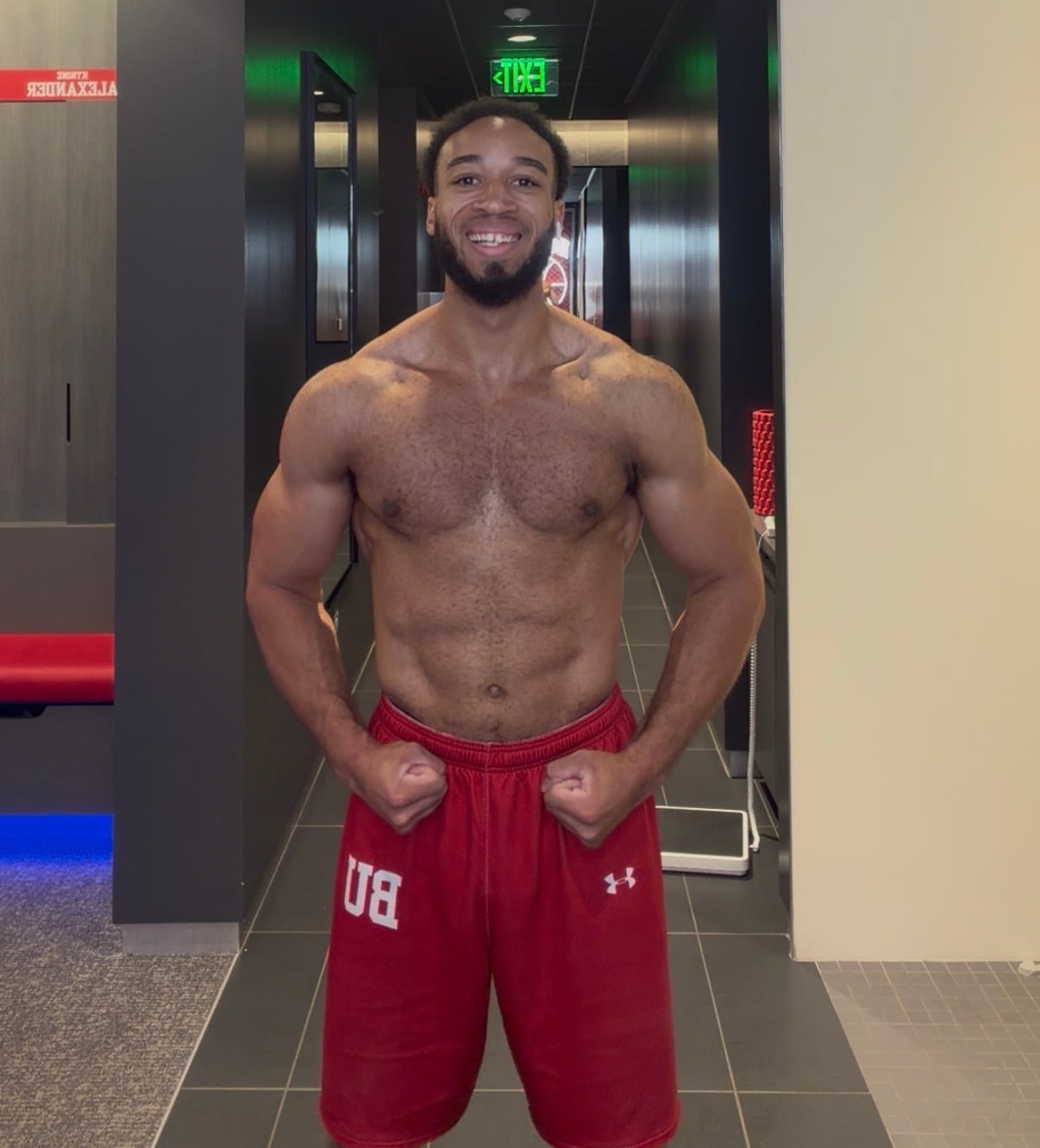
On any given day, Spencer Joyner is juggling what could easily be three full-time lives. He is a senior at Boston University studying Human Development with a specialization in child and adolescent mental health. He is still a member of the Terriers’ basketball program, now in a supporting role off the court. And he is building Phoenix Hybrid NBAR, an online fitness coaching business with a mission that reaches well beyond the weight room.
“I help men turn their pain into purpose,” reads the bio on his Instagram. For the 22-year-old, raised in Harlem and now based in Hackensack, New Jersey, that line isn’t a marketing slogan. It’s a summary of his life so far.
The NBAR stands for Never Broken, Always Reborn, a philosophy Joyner says he arrived at the hard way.
A Childhood Diagnosis With No Easy Answers
In 2017, when Joyner was 12 years old and in the seventh grade, he was diagnosed with pseudotumor cerebri. The rare condition causes pressure to build inside the skull and mimics the symptoms of a brain tumor. He recalls doctors telling his family he didn’t fit the typical profile for the disorder and that they couldn’t explain why he had developed it.
The symptoms upended his childhood. He suffered severe headaches and dizziness, and his sensitivity to light kept him in dark rooms. He struggled to regulate his body temperature and to concentrate for any length of time. He needed eye exams twice a week to protect his vision. He underwent MRIs, CT scans, constant blood work and repeated spinal taps to relieve the fluid pressure. A daily regimen of medication and steroids left him exhausted and gaining weight, and for long stretches he could barely walk.
When doctors recommended shunt surgery, a permanent procedure to drain fluid from the brain, his parents declined. Nearly a year in, his father, a fitness trainer, met someone at a park who had faced a similar condition and credited a holistic practitioner with his recovery. The family decided to try the same route. Joyner says that within about three weeks his symptoms had resolved, and he slowly relearned how to move, returned to school and got back on the basketball court.
His story drew news coverage after NBA star Kyrie Irving paid his tuition and hospital bills. Joyner was attending The Patrick School at the time, Irving’s former high school, and his coach told Irving about his situation. Joyner has never met Irving in person. “I hope to get that opportunity one day to tell him,” he says, meaning to finally thank him.
Fighting the Battles No One Could See
The physical recovery was only part of the story. Joyner says he struggled with his mental health from a young age but kept it to himself until his junior year of high school. That year he reached a breaking point and attempted to take his own life. He credits his sister, who happened to knock on the door at that moment, with interrupting him. That night, he called his high school coach and his father and, for the first time, told them what he had been carrying.
At 17, he was admitted to a mental health facility and diagnosed with depression and anxiety. The following year, as a high school senior, his symptoms returned more severely, this time including episodes of psychosis, and he was hospitalized again.
Basketball, meanwhile, had become both his path forward and a weight. He picked up a ball at 3, played organized ball from 7, and earned a full Division I scholarship to Boston University. A torn hamstring cost him most of his sophomore season. By the end of that year he made what he calls the hardest decision of his life: stepping away from playing. The university allowed him to keep his full scholarship and stay with the team in a supporting role.
“Basketball was my first life,” Joyner says. Walking away, he adds, gave him room to focus on his health and to find out who he was without the game. He found a new therapist in college, deepened his relationship with his faith and leaned on a strong support system. He says he is now in the best place mentally he has been in years.
Building Phoenix Hybrid NBAR Into a Movement
In the summer of 2025, Joyner began posting fitness content online. That December, he launched Phoenix Hybrid NBAR as an online coaching business. Earlier this year he brought on mentors to help him scale it, all while carrying a full course load.
The gym was never only about the physical for him. Growing up around his father’s training work, Joyner says, workouts became a safe space and an outlet for emotions he didn’t always know how to voice. “It became my therapy,” he says.
The brand’s name reflects that history. The phoenix represents rising from difficult seasons renewed and stronger. The hybrid describes a different breed of person, one who builds strength, endurance, athleticism, mental toughness and discipline together. “You are not defined by what you’ve been through,” Joyner says, “but by your ability to rise, rebuild, and keep becoming.”
So far, his clients have mostly been athletes and people with active lifestyles. Now he is turning his focus toward men who look strong on the outside while privately struggling with anxiety, depression, overthinking or a loss of identity. He describes his coaching style as observant and adaptable. He learns a client’s background before writing a plan, then pairs empathy with accountability when they fall short. “I believe in leading with empathy, listening before judging,” he says, while still pushing each client toward his full potential.
His ambitions are big. Joyner wants to launch an NBAR clothing line and host events that bring together fitness, personal growth and mental wellness. He also wants to give back to communities in need and one day partner with brands like Nike and Beats by Dre. The goal, he says, is to turn Phoenix Hybrid NBAR into a global movement for anyone trying to rebuild after hardship.
For now, he is taking his own advice to other young founders: don’t wait until everything is figured out. “Just start,” he says, “and you will figure out how to improve on the way.”
Never broken. Always reborn.
If you or someone you know is struggling or in crisis, call or text 988 to reach the 988 Suicide & Crisis Lifeline in the U.S.