



























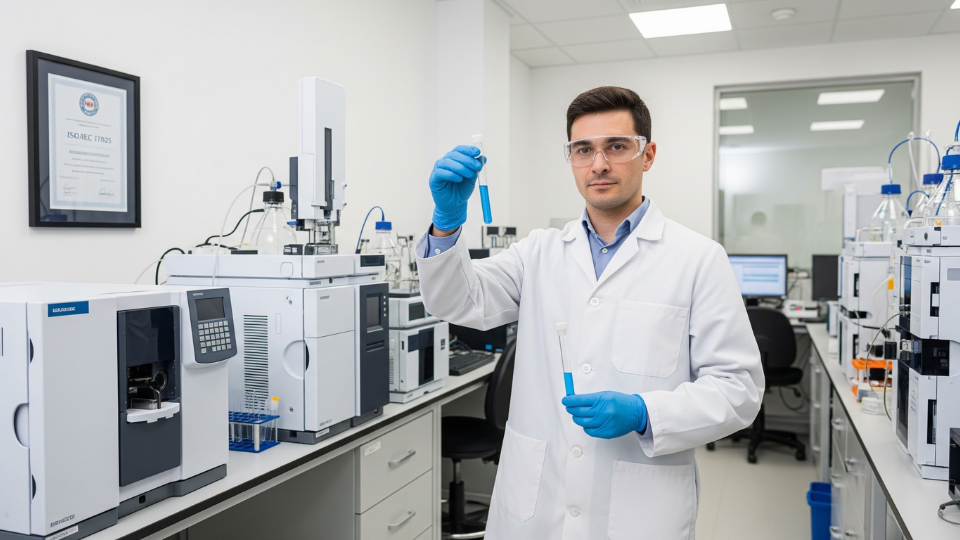
Trust is fragile in the testing industry. One inaccurate result can ripple through supply chains, jeopardizing safety and brand integrity in a matter of days. For companies producing cosmetics, pharmaceuticals, or consumer goods, the credibility of their testing partner determines whether their product stands up to scrutiny or crumbles under it.
This article examines how ISO/IEC 17025 accreditation safeguards scientific precision and why Qalitex’s accreditation is a mark of global trust and reliability.
Understanding ISO/IEC 17025 and Its Role in Testing Integrity
Before exploring how Qalitex applies this standard, it helps to understand what ISO/IEC 17025 means and why it is the benchmark for testing competence worldwide.
What ISO/IEC 17025 accreditation means
ISO/IEC 17025 is the international standard that defines what makes a testing or calibration laboratory technically competent. It goes beyond paperwork and quality manuals as it examines how results are produced.
Unlike ISO 9001, which focuses on management systems, ISO/IEC 17025 measures a lab’s technical competence. It verifies that analysts are qualified, instruments are calibrated, and test methods are validated. Every accredited laboratory must demonstrate that its procedures consistently produce accurate, traceable, and reproducible data.
Why this standard matters for consumer safety
For industries that deal with human health, a single unreliable result can have far-reaching consequences. ISO/IEC 17025 ensures that the data used to approve a new skincare product, supplement, or medication reflects real performance and safety.
When laboratories uphold this standard, manufacturers can confidently release products knowing that quality and safety have been scientifically verified. The end result is a safer marketplace and stronger consumer trust.
How accreditation builds confidence with regulators and clients
ISO/IEC 17025 accreditation is globally recognized through ILAC (International Laboratory Accreditation Cooperation). This means data from accredited labs like Qalitex is accepted by regulators across multiple jurisdictions, including the FDA, Health Canada, and the European Medicines Agency.
Accreditation also shortens approval timelines. When a company submits data from an ISO/IEC 17025-accredited lab, it reduces the need for repeated testing or secondary verification. That saves time, resources, and potential compliance headaches.
How Accreditation Ensures Accuracy and Reliability
Accreditation is not a symbolic achievement. It is a demanding framework that determines how every sample is tested, how instruments are maintained, and how results are verified before being reported to clients.
Ensuring precision in testing equipment and procedures
ISO/IEC 17025 requires laboratories to prove that their instruments are properly calibrated, maintained, and routinely checked for performance accuracy. This applies to everything from balances and pH meters to chromatographs and spectrometers.
At Qalitex, calibration logs are living records. Every instrument’s history can be traced, reviewed, and verified, ensuring the data it produces stands on solid technical ground.
Periodic proficiency testing further validates accuracy. This process compares Qalitex’s performance with peer laboratories, confirming that its results are not just consistent internally but reliable against global benchmarks.
Minimizing human error and bias through standardization
Human skill remains central to testing, but human error is also a risk. ISO/IEC 17025 eliminates subjectivity through strict standardization of methods, documentation, and reporting.
Each procedure, from sample preparation to data recording, is governed by written protocols that leave no room for personal interpretation. This uniformity guarantees that two analysts working independently can achieve the same outcome under the same conditions.
“Behind every test result is a team that understands what reliability truly means,” said Nour Abochama, VP for Operations at Qalitex. “ISO/IEC 17025 accreditation does not only validate our methods. More importantly, it validates our people’s commitment to doing science the right way.”
How traceability and documentation reinforce accountability
Every sample tested in an accredited laboratory follows a fully traceable journey, from receipt and labeling to analysis and reporting. ISO/IEC 17025 mandates complete documentation at every step, allowing auditors or clients to reconstruct the process at any time.
This level of traceability ensures transparency. If a manufacturer or regulator questions a result, Qalitex can demonstrate exactly how that data was produced, who performed the analysis, and what equipment was used.
Bullet points summarizing how traceability works in practice:
- Each sample receives a unique identifier to prevent mix-ups.
- Chain-of-custody logs track the sample’s movement and condition.
- Every test is cross-referenced with instrument calibration records.
- Final reports include quality checks and sign-offs by authorized personnel.
The Cost of Non-Accredited Testing
Not all laboratories hold ISO/IEC 17025 accreditation, and the difference can have serious consequences.
The risk of inconsistent or rejected results
Data from non-accredited labs often lacks the verification needed for regulatory acceptance. Agencies may reject results if the lab’s competence cannot be proven, forcing manufacturers to repeat costly tests. This delay can affect product launches, compliance deadlines, and even market access.
The impact on brand reputation and consumer trust
A single recall linked to inaccurate testing can permanently damage a brand’s reputation. Consumers remember companies that cut corners, not those that meet the minimum standard.
Accredited testing, therefore, acts as a form of brand protection. It ensures that every safety claim, ingredient label, and efficacy statement rests on scientifically defensible evidence.
Inside Qalitex’s Accredited Testing Process
At Qalitex, ISO/IEC 17025 accreditation is not a label that sits on a certificate. It’s woven into how the laboratory operates each day. Every process, from how a sample arrives to how results are verified, follows a methodical structure that reflects both technical rigor and human discipline.
How accreditation shapes daily laboratory practice
When a sample enters Qalitex’s facility, the process begins with strict chain-of-custody verification. Each sample is logged, labeled, and assigned a unique tracking code. Analysts follow standardized protocols to prepare, test, and record data under controlled conditions.
Instruments undergo daily calibration checks before use. Data entries are reviewed by multiple layers of quality assurance personnel. Even the temperature and humidity in testing rooms are monitored and logged to prevent environmental interference.
Every action is traceable and auditable. This means that if a regulator ever requests proof of accuracy, Qalitex can demonstrate the complete journey of that result, from the original sample to the final signed report.
The human element in quality control
Accreditation requires more than calibrated instruments. It demands skilled, vigilant professionals who understand the responsibility of their work. Qalitex invests heavily in staff training, internal audits, and technical workshops to ensure continuous competence.
Analysts are routinely evaluated for accuracy and procedural consistency. Their expertise transforms the accreditation framework from a set of rules into a living culture of excellence.
“Technology drives precision, but people uphold integrity,” said Nour Abochama. “Our analysts understand that ISO/IEC 17025 is a daily discipline that protects the brands and consumers we serve.”
Qalitex on Chemical and Microbiological Testing
Among Qalitex’s accredited services, chemical and microbiological testing best demonstrate the company’s adherence to ISO/IEC 17025 principles. These tests protect consumers from harmful contaminants and ensure that every ingredient and formulation meets international safety and efficacy standards.
How Qalitex conducts chemical testing
Chemical testing verifies what a product contains and what it doesn’t. Qalitex’s laboratories analyze active ingredients, preservatives, heavy metals, and trace contaminants to confirm compliance with both client specifications and regulatory limits.
Under ISO/IEC 17025, each analytical method must be validated before use. This involves demonstrating precision, accuracy, detection limits, and reproducibility. Instruments such as HPLC, GC-MS, and ICP-OES are routinely calibrated against certified reference materials to guarantee data integrity.
In practice, chemical testing under accreditation follows a strict sequence:
- The sample is logged and prepared under contamination-free conditions.
- A validated test method is selected and referenced to international standards.
- Results are reviewed by quality control officers and approved only when all acceptance criteria are met.
This structure ensures that every reported value represents verified science, not assumption. It also helps clients meet stringent requirements for FDA or Health Canada submissions with confidence.
How Qalitex performs microbiological testing
Microbiological testing verifies that a product is free from harmful bacteria, yeast, or mold that could compromise safety. Qalitex’s laboratory performs microbial limits testing, total aerobic counts, yeast and mold counts, and pathogen detection.
The process demands meticulous environmental control. Air quality, surface sterility, and analyst technique all affect outcomes. Each step is governed by standard operating procedures aligned with ISO/IEC 17025 and pharmacopoeial references such as USP and EP.
Microbial testing matters most in products that come into direct contact with the skin or are ingested, where contamination can lead to recalls or adverse events. Accreditation assures clients that these tests are not only scientifically valid but defensible in any audit or regulatory review.
Why clients choose accredited testing partners
Partnering with an accredited lab like Qalitex provides several measurable advantages:
- Recognized data: Results are accepted by regulators and international partners without revalidation.
- Reduced risk: Accreditation minimizes exposure to compliance issues and regulatory delays.
- Confidence and reputation: Brands that use accredited labs demonstrate accountability to both customers and regulators.
Why ISO/IEC 17025 Matters for the Future of Quality Assurance
Accreditation is not a one-time achievement. It is a continuous process of reassessment, improvement, and adaptation to new scientific standards. The laboratories that treat accreditation as a living framework are the ones that stay ahead of global regulatory expectations.
The growing demand for globally recognized test data
Global trade has made harmonized standards essential. When data from one accredited lab is accepted across regions, it eliminates costly duplication and fosters transparency.
For multinational manufacturers, this consistency ensures that the same product tested in California, Toronto, or Dubai will meet identical analytical expectations. Qalitex’s ISO/IEC 17025 accreditation situates it within this international trust network, allowing its clients to confidently distribute products across regulated markets.
Continuous improvement as part of accreditation culture
The true strength of ISO/IEC 17025 lies in its demand for evolution. Laboratories are required to conduct regular internal audits, proficiency testing, and management reviews. At Qalitex, these reviews are opportunities for growth rather than compliance exercises.
Each audit cycle sharpens precision, introduces new technology, and reinforces accountability. This continuous improvement model ensures that Qalitex’s test data remains not just compliant but cutting-edge in accuracy and relevance.
Final Thoughts
Trustworthy testing results are not built overnight. They are the product of disciplined systems, transparent processes, and people who take science personally.
ISO/IEC 17025 provides the global framework for that trust. Qalitex’s accreditation within this standard confirms that its testing is defensible, traceable, and globally recognized, a foundation every manufacturer can depend on.
Through its accredited chemical and microbiological testing, Qalitex continues to prove that integrity in science is not declared, but demonstrated.